

Why You Can’t Slow Down: Burnout, Self-Care, and the Pressure to Always Be Productive
You know you are tired. You know you need rest. But when you finally slow down, it just feels…uncomfortable.
You feel guilty and anxious. And you start thinking about everything you should be doing instead. So you find work to do, and you find ways to stay busy.
Many people think burnout happens because you are doing too much. But that’s one part of it. There is a deeper aspect to chronic burnout.
For many 1.5 and second generation Asian Canadians, burnout is not as simple as having too much on your plate. It is also about the relationship you have with yourself, and about the beliefs you learned around responsibility, success, productivity, and your own worth.
If self-care was that simple, you would not keep struggling with it…feeling uncomfortable when you rest, overthinking everything, finding things to do to keep yourself busy…these are all indications that there might be a deeper-seated issue.
How you approach self-care is shaped by your upbringing, your experiences, and how you learned to relate to yourself and to others. For many people, especially those who grew up in immigrant families, this struggle is not random. It’s learned behaviour.
Why Self-Care Feels So Hard When You’re Burned Out
Here are six common reasons behind burnout and difficulty with self-care.
1. You learned You Had To Be Responsible
You take on a lot. You sometimes even take pride in it. Work, family, relationships, and expectations. Part of this comes from care, part from pressure, and part from self-esteem and identity.
For many people who grew up in immigrant families, being responsible was expected of you. You learned early on that you have to help out. That you have to meet expectations of the family, academics, and achievements. You learned that it was the norm for things to feel hard.
Over time, the pressure begins to feel normal. And you slowly internalize the link between your achievements and your self-worth and identity. That’s why it feels uncomfortable when you try to rest. Because your norm is to be busy. And the busyness is also connected to your sense of self-worth and identity.
When you have time to rest, you may worry that things might go wrong if you’re not vigilant. You might feel guilt and shame for being selfish, and you worry that you might be letting others down. So instead of resting, you just keep doing things.
These ways of thinking and feeling can often be connected to deeper psychological patterns such as parentification, people-pleasing, self-judgment, and codependency. These psychological patterns may have helped you survive and succeed. But when you are used to always having to meet expectations and achieve, stepping back can feel uncomfortable. Scary, even. So you just don’t.
2. You May Have Experienced Emotional Neglect
Emotional neglect can be hard to identify, because it’s not characterized by something bad that happened to you. Rather, it is about something lacking that you never received growing up.
Children need emotionally safe relationships to grow up into a healthy, emotionally mature adults. But many children never receive emotional safety from their parents. Their parents may have taken care of their physical and biological needs by providing food and shelter. But the parents may have struggled when providing emotional nurturing and safety.
This means that the parents were not able to develop an emotional bond with their children. And they may not have been able to teach their children how to understand their emotions, nor allow them to feel safe to express their emotions.
As a result, the children grow up lacking the skill to connect with their own emotional world. This means struggling to understand how you are feeling, what you want, and what you need.
If you want to learn more about emotional neglect, you can read this article: Signs You Grew Up With Emotional Neglect
3. You Were Taught To Prioritize Others
Some of us might be raised in a home where we were taught to “help out.” Many Asian cultures emphasize values like filial piety, responsibility, and caring for family. In my own upbringing, I was given the sentiment of “family is everything.” There’s even a saying in Chinese, 血濃於水.
These values can be a double-edged sword. On one hand, they can create beautiful relationships. They teach us gratitude, connection, and commitment. In a healthy family dynamic, these values create deep connections and reciprocity to ensure everyone is taken care of and valued.
But what happens when the family dynamic is not healthy? When you’re forced to sacrifice your own needs? And where some family members might be abusive to others, or might take advantage of these cultural sentiments. In such dynamics, we can get stuck in unhealthy relationship patterns where we feel guilty and ashamed for wanting to prioritize ourselves, our needs, our decisions. We struggle to say no, and we’re left exhausted.
Learning to balance your needs with the needs of others is an important part of emotional health.
I explore this pattern more here: Why You Self-Sacrifice in Relationships: Filial Piety in Asian Families
4. You Were Never Taught How To Take Care Of Yourself
If no one modeled self-care for you, it is not something you would naturally know how to do.
In many families, survival, stability, and sacrifice were prioritized. Sometimes for multiple generations. Rest, emotional awareness, and personal needs were not always part of the conversation. I explore this intergenerational pattern here: Emotional Neglect in Asian Immigrant Families Explained
You may know you need self-care. But you may not know what it actually looks like in your life. Self-care is not just taking a vacation or doing something relaxing. For many people, it means learning something they were never taught growing up.
Learning these new skills is not fun, because these skills can lead to unpleasant emotions. This includes learning how to notice your emotions (beyond anger), setting healthy boundaries, tempering your inner critic to learn self-compassion, and understanding your needs beyond enmeshed family needs.
Though you were not taught or modeled these skills growing up, it is well worth learning them now. They have the ability to shift your life.
5. Self-Care Requires Change, And Change Is Uncomfortable
Real self-care requires an internal shift, to change the way you relate to yourself and to others. It can feel daunting, because these internal changes are so counter to what we are used to. It can actually feel unsafe when we build these new skills, and can bring up a lot of emotions.
Often, the behaviours that have helped keep us safe are the same behaviours that are leading to burnout: productivity, people-pleasing, perfectionism, structure and routine, rigidity.
But we’re not looking to completely get rid of these behaviours. Perfectionism is good…in the right circumstances. Rigid structures and routines can be helpful…when necessary. We want to view these behaviours as a set of skills/tools that we have in our toolbox. And we will use each tool only when it is the correct tool for the problem.
Change is simply building a wider set of tools/skills. And yes, this process will feel uncomfortable. But discomfort does not mean you are doing something wrong. The discomfort might just be a sign that you are changing a pattern.
6. You Feel Like There Is No Time
Since your natural state of being is to keep busy, then it makes sense that you feel like there’s no time for self-care. Your schedule is full because you have designed your life that way. Your mind is full, and body exhausted because there’s always been an internal pressure to keep doing more, adding more, and putting others ahead of yourself.
So self-care feels like "one more thing" on an already overwhelming list. If you’re trying to “fit” self-care into your schedule, then you’re doing it backwards. We want to intentionally create time and space for self-care, where all our other tasks must revolve around or accommodate for. Self-care should not be the last thing on that list to “fit” into your schedule.
This is not a matter of discipline, nor better time management. You’re simply carrying too much in the first place. Self-care needs to be prioritized, with intention.
Why You Still Can’t Slow Down (Even When You Know You Should)
For many of us, we can’t slow down because we are stuck in a psychological and emotional pattern. A lot of times, we might experience:
Guilt and shame when we rest
Anxiety when we’re not being productive
Constant thoughts about what we should be doing (overthinking and rumination)
Feeling like we’re not doing enough (guilt and shame)
For a lot of us, rest was never a luxury we had. We were taught that there was always something else to do. Expectations to meet. Obligations to fulfill. Problems to fix. More things to achieve, do, and improve. Rest or slowing down was shamed, criticized, punished, or viewed as unsafe.
And the result? Your mind learned that rest is uncomfortable, and staying busy is safer. You can’t slow down because it feels psychologically unsafe.
The Burnout Cycle: Why Rest Feels Uncomfortable
The burnout cycle comes in a distinctive pattern that you can analyze using the CBT Triangle. It looks at the relationship between your thoughts, feelings, and behaviours.
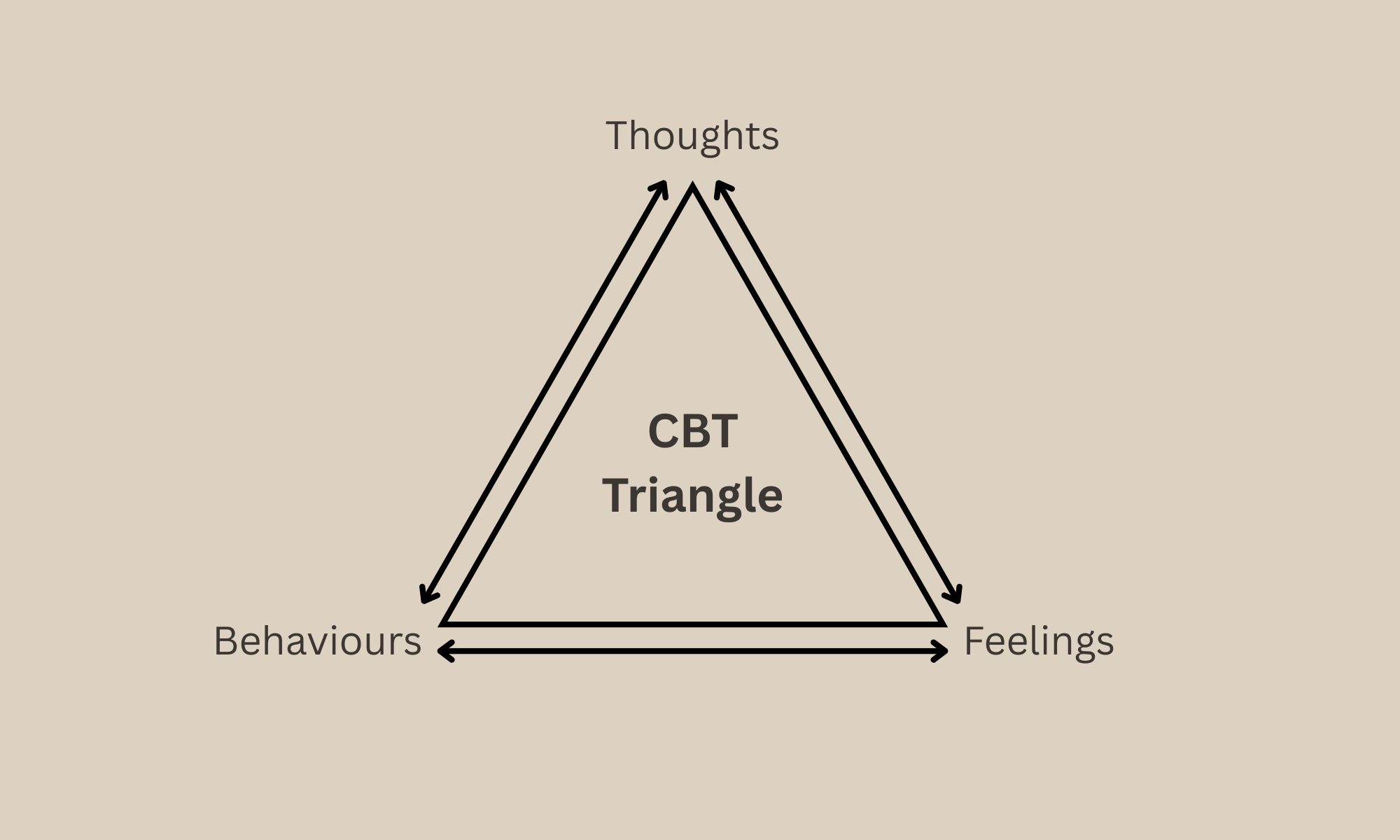
Using the CBT Triangle can help you understand the relationship between your feelings, thoughts, and behaviours.
For example: After a long week of work, you finally have free time to rest. Let’s use the CBT Triangle to understand your internal process:
Your feeling: Guilt and/or anxiety.
Your thought: "I should be doing something more productive."
Your behaviour: You go back to working, organizing, or finding another task. Or you make self-care into a task to check off the to-do list.
In the short term, staying busy reduces the uncomfortable feeling. But over time, your brain learns that rest creates discomfort. Productivity creates safety. This is how burnout cycles continue.
The Real Cause of Burnout: When Your Identity Is Tied to Productivity
There are several patterns I see often:
Your identity is tied to what you do for others. You become the helper, the people-pleaser, the problem-solver, the responsible one.
Your identity is tied to your success. Your self-worth shifts based on your accomplishments and what you consider to be markers of success. It might be how much money you make, the size of your house, your work title, your work metrics, etc.
Your identity is tied to being the “good one.” You view yourself through the lens of the “goodness” that you do. Helping those in need, supporting family, donating to charities, attending church/temple/mosque, mentoring others.
Your identity is tied to your family role. Fulfilling the expectations of the “good” son or daughter. Being a “good” father, mother or family member.
You might see yourself in some of these patterns. Or maybe in all of these patterns. You might take pride in it, and/or it can come from love. However, it also comes from a lot of unspoken expectations that you have internalized ever since you were young.
When your identity and self-esteem become connected to being useful or successful, doing less can feel like you are failing. It can impact your sense of self-worth and identity.
Healthy self-esteem and an aligned identity are not defined by pleasing others, material success and life achievements, performing “goodness,” or fulfilling family expectations. Your life should also include:
Reciprocal relationships, not just unidirectional people-pleasing
Pride for your successes, but also gratitude for the things you have
Alignment with your values and a balanced approach to enacting upon them (“doing good”)
Balance of your family roles and your independence
This is where self-care becomes more than just taking a break. It requires you to re-discover your deeper sense of self. We need to learn to untangle the net of family enmeshment that we grew up within, so we can develop an identity that balances our roles as a family member, our productivity/achievements, and our own independence.
What Self-Care Actually Looks Like (Beyond Bubble Baths and Breaks)
A simple way to think about self-care is through three areas:
Mind
Your thoughts, emotions, and mental space. This includes learning to process emotions, examining unhelpful beliefs, and creating space for yourself. We want to do this while engaged in self-compassion.
Body
Your physical health and nervous system. This includes sleep, movement, nutrition, and learning how to regulate stress and trauma held in your body.
Spirit
The things that bring curiosity, joy, creativity, and meaning. This includes hobbies, relationships, and activities that make you feel alive.
Most people neglect at least one of these areas. Balance matters more than perfection.
How to Start Self-Care When You Feel Too Overwhelmed
If self-care feels difficult, here are some tips to get started:
1. Make it easy
Don’t create a perfect routine. Start small. Choose something you can realistically follow through on. Consistency matters more than intensity. Do not make self-care another thing to perfect and “accomplish.”
Bad Example: “I will complete a 1-hour yoga routine every night before bedtime.”
Good Example: “I will try a 15-minute yoga routine every Saturday morning and see how that goes.”
If you aren’t able to do it, don’t beat yourself up for it. Just remember that some days are easier than others. Be kind to yourself.
2. Make it enjoyable
If you hate it, you will not continue with it. Self-care should not become another obligation. Start with something that brings you energy and joy.
Bad Example: “I hate reading, but I hear that it is very good for you. I will read 20 pages of a novel every night for my downtime. “
Good Example: “I love Ghibli music, it brings me back to my childhood. I will listen to some Ghibli music on Friday nights to settle myself after a tiring week of work.”
Of course, you’ll eventually have to do things you don’t want to do. For me, that was yoga. But when you first start off, find a task that you find fun and enjoyable.
3. Schedule it intentionally
If it is not planned, it usually doesn’t happen. Treat your own needs as something important.
Bad Example: “I will rest when I have time between work.”
Good Example: “I will schedule a minimum of 15 minutes between meetings, so I can get up, move my body, and rest my mind.”
4. Expect guilt
Guilt, anxiety, and overthinking may show up. As we previously said, change isn’t easy. And you’re changing patterns that had kept you feeling safe for many years. Don’t judge yourself when you feel guilt, anxiety, shame, or any other feelings that come up. These feelings are normal.
How to Create More Time When You’re Already Burned Out
The mistake some of us make is to think that self-care alone can fix our burnout cycle. In reality, self-care needs to come in tandem with doing less. That means reducing the amount of things we are carrying. There are three ways to do this:
1. Eliminate Tasks
Ask: "Does this actually need to be done?"
You’ll be surprised how many things are not essential. I had one of “those moments” when I was at Fan Expo that you can read here: How Perfectionism and Fear Makes You Productive But Unfulfilled.
2. Automate Tasks
Ask: "Can this happen without my constant attention?"
You may need to think creatively to create automations. For example, automate your credit card payments. Or setting up a robot vacuum.
I write about my decision to buy a Roomba here: Why Asian Immigrants Find It Hard To Spend Money On Ourselves
3. Delegate Tasks
Ask: "Does this have to be me?"
For many people, delegation is the hardest one. We’re just so used to doing everything ourselves. We might feel guilty for burdening others, feel ashamed for not being able to “manage” on our own, or worry that others just can’t/won’t do it.
But these beliefs are often connected to the same patterns that contribute to burnout. Learning to receive support is also part of self-care.
Why Burnout Doesn’t Go Away by Doing More
Most people try to fix burnout by doing more. More habits, more structure, more effort. They are essentially applying to their self-care the same methods that burnt them out in the first place.
Instead, the shift comes from understanding your patterns. Ask yourself these questions:
When I give myself time to rest, what am I feeling?
What are the thoughts that come up with these feelings?
Do I recall past memories that might be linked with these thoughts and feelings?
The goal is not to become less ambitious. The goal is to create a life where your worth is not dependent on how much you accomplish or how happy you can make others feel.
What is one small thing you can remove, instead of add?
If Burnout Resonates With You, Start Here
If this articles resonated with your experience, you’re not alone. These patterns are very common, especially for many of us in the Asian diaspora. The below articles can help you understand your internal processes that lead to chronic burnout.
Why You Can’t Slow Down (Root Causes)
If you’ve ever thought “why do I feel like this even when life is okay?”, these will help you understand where burnout starts. It starts here:
Signs You Grew Up with Emotional Neglect
Learned Helplessness in Immigrant Families: Why You Feel Stuck
You might also explore:
Asian Perfectionism Pressures
Why Rest Feels So Uncomfortable (Patterns That Keep You Stuck)
Burnout is not just about your schedule. It is also about the patterns your mind learned to keep you going. These explains:
Why You Can’t Rest: Trauma, Productivity, and Model Minority Myth
Why You Can’t Change Your Life Even When You Want To
You might also explore:
Why Asking For Help Feels So Hard
When Burnout Starts Affecting Your Life (Impact)
Over time, burnout does not stay manageable. It starts to impact your relationships, your work, and how you feel about yourself.
How Perfectionism and Fear Make You Productive But Not Fulfilled
Workplace Bullying and Trauma: How to Stop People-Pleasing
You might also explore:
How to Move Beyond Anger and into Authentic Living
If You’re Ready to Start Changing It (Recovery)
Burnout does not go away by pushing harder. These articles focus on what actually helps shift these patterns over time.
Healing from Trauma: Why Your Life is Not Wasted and You are Entering Your Second Prime
Learned Helplessness From Trauma and How to Rebuild Personal Agency
You might also explore:
9 Stages of Journaling for Mental Health: How Emotional Processing Evolves Over Time
For many people, burnout and overthinking are closely connected
When your mind never turns off, your body never fully rests. Burnout is often connected to deeper emotional patterns.
You may notice:
Constant overthinking
Feeling like you are never doing enough
Difficulty relaxing even when life is going well
Fear of disappointing others
I explore these patterns more here:
Why You Overthink (And How to Actually Stop)
Learn how anxiety, perfectionism, and internal pressure can keep your mind stuck in constant problem-solving mode, and why we can’t “problem-solve” our way out of our emotions.
Why You Can’t Rest Even When You Know You Need It
Understand why slowing down can feel uncomfortable, and how to build a healthier relationship with rest.
If you’re recognizing yourself in these patterns, this is the kind of work I focus on. Hi, I’m Harry, a psychotherapist in Toronto. I work with 1.5 and second generation Asian Canadians navigating trauma, identity, and emotional patterns shaped by family and culture.
If you want a simple way to support your mental health, you can join my 1-Minute Mental Health Task, where I share a small practice every week to help you build more calm, connection, and well-being in your daily life.
